RETURN2GREEN CALLS ON MINISTER OF FOOD AND AGRICULTURE
Ms. Lily He of Return2Green International and Professor Zhou made a call on Hon. Kwesi Ahwoi, Minister of Food and Agriculture, and Cecilia Erzuah, Director of Finance and Administration for the Ministry. Ms. He and Professor Zhou were invited to the Minister’s office to discuss the wide ranging benefits of using agriculture waste and plant fiber with Prof. Zhou’s MZ-3 manufacturing technology.
Full discussions were conducted on ways to capitalize on the technology and the immense benefits Ghana will realize by turning agriculture and plant fiber waste to create a wide range of environmentally friendly biodegradable products for a broad spectrum of industries.
Minister Ahwoi and Cecilia Erzuah, expressed their full support and appreciation to Return2Green International and Prof. Zhou for bringing the technology to Ghana. They are confident it will bring added status to the country’s agriculture and food production sectors as well as improving Ghana’s farmer economic status.
Mr. Kojo Yankah, President of Africa2Green, was also present at the meeting.
You can file this one under "slightly off-beat". Not only because it's a $1.5 billion Star Trek theme park that runs at least in part on "green energy", but because it's going to be in Jordan. I'm not sure if the local trekky population can commercially support such a thing, or if worldwide trekkies will make the trip (too bad teleportation isn't ready for prime time). Oh well, I suppose having King Abdullah of Jordan as a backer of the project and big fan of the show should be enough to make it get off the ground.
According to HME: "The themed entertainment destination will also serve as a model for "green energy," incorporating state-of-the-art renewable technologies throughout the facility, and hosting a "future" pavilion where businesses, students and attendees can learn about alternative energy sources ranging from solar and wind energy to greywater harvesting."
Check out these great futuristic ideas for clean, green metropolises that produce their own power by the wind and sun, and feed themselves from transparent skyscrapers that are planted up and down with hydroponic gardens.
Today, Philips announced that their Philips Ambient LED 12.5 watt light bulb — which gives off as much light as incandescent 60 watt bulbs, using less energy — attained Energy Star qualifications. It’s the first LED light bulb of this type to gain approval in the U.S. Environmental Protection Agency sponsored program. Energy Star sanctioned products are usually eligible for utility rebate programs that can lower the cost of a product for consumers, while allowing a company to keep their margins strong.
According to Philips, its bulb lasts 25 times longer and uses 80 percent less energy than the 60 watt incandescent bulb it was designed to replace. A company press statement reported that in order to obtain the Energy Star label, its LED bulb had to demonstrate a minimum light output of 800 lumens, a color temperature of 2700K (for soft white light), color rendering index (CRI) of 80 and a minimum three-year warranty; it actually offers 806 lumens, 2700K, a CRI of 80 and a six-year warranty. The bulbs are currently selling at Home Depot for $39.97.
A Philips company representative told TechCrunch the bulbs are also recyclable. The lighting corporation wasn’t issuing predictions about how much the Energy Star qualification would drive sales of its Ambient 12.5 watt bulbs. More macroscopically, however, Philips predicts LEDs will take 50 percent of the residential lighting market by 2015.
Other companies are sure to follow in Philips’ footsteps, from large and medium-sized businesses like Cree (NASDAQ: CREE) and the Lighting Science Group Corporation (OTCB: LSCG) to younger startups like Bridgelux.
The Durham, N.C.-based Cree now has a demonstration 60 watt incandescent replacement LED bulb — the TrueWhite Light — that the company claims is the industry’s brightest and most efficient, and meets Energy Star performance criteria. A company spokesperson said Tuesday that Cree submitted it to an independent testing facility, with testing on track to be completed by the fall. (Energy Star doesn’t test bulbs for certification.)
Meanwhile, LSCG has an Energy Star approved line, called DEFINITY. Bulbs in this line, the company announced today, have been installed in Yankee Candle Stores throughout New England. LSCG claims these are approximately 80% more efficient than the halogen bulbs that they replace, are “dimmable,” contain no mercury, and are completely recyclable. Yankee Candle received rebates from National Grid and Western Mass Electric Company through the Mass Save program, and other electric utility companies throughout New England.
The Cincinnati Zoo has begun installing a solar power array that it hopes will provide about a fifth of the park's energy needs by April.
The zoo says it will be the country's largest urban solar array that is accessible to the public.
The Cincinnati Enquirer reports that workers began installing the first of 6,400 panels on metal canopy structures Wednesday.
Melink Corp. of nearby Clermont County is the developer and designer of the project and will own and operate the 1.56-megawatt system, which costs about $11 million.
An interactive kiosk will explain to zoo visitors how the array works and how much energy is being produced.
Partly cloudy, blue skies and sunshine. Thursday was a nearly perfect day to showcase the Wyandot Solar Farm, the largest solar electric-generating plant in Ohio.
"We're really flipping the switch on the future," said Gov. Ted Strickland, who was among the dignitaries who gathered for a formal dedication of the solar farm about three miles northwest of Upper Sandusky.
"Because we made a commitment to advanced energy in (the Legislature), the sun will not only power Ohio homes, it will power Ohio jobs," the governor said.
Strickland said Ohio was ranked first in the nation last year in the creation of green energy jobs.
The solar farm also showcases "solar panels made in Perrysburg. Installed by Ohioans. And creating clean, renewable energy for Ohio businesses," Strickland said.
"Ohio is a leader in advanced energy," he said. "You can see that right here."
The 80-acre solar farm is adjacent to the Wyandot County airport, off Wyandot County 44 and Ohio 199. Public Service Enterprise Group, a New Jersey-based energy company, owns the project.
The farm will provide a "new harvest" of "clean, renewable energy which we will quietly produce and deliver to (American Electric Power) customers for decades to come," said Diana Drysdale, vice president of Public Service Enterprise Group Solar Source, a subsidiary of the owner.
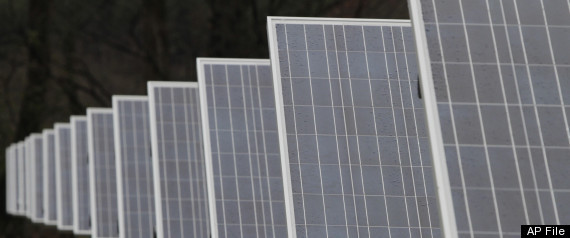
The farm has more than 159,000 ground-mounted solar panels and can produce 12 megawatts of electricity, enough to power more than 9,000 residences. A megawatt is one million watts.
The solar farm is an example of "a clean, green financially robust future," for Ohio, Drysdale said.
"It's the dawn of a new era for the state," Strickland said. "We're at the forefront of an energy revolution."
"Following the light of the sun we have left the Old World," he said, quoting Christopher Columbus. "That's exactly what we're doing today," Strickland said.
Construction began in November 2009 and was completed in late spring. The solar farm began producing electricity in June. Electricity is not generated at night or when it is cloudy.
"The Wyandot Solar Farm points the way forward, and is both an environmental and economic win," said Ralph Izzo, Public Service Enterprise Group's chairman, chief executive officer and president.
"As a nation, we can all benefit from a future with more green energy that improves our energy security, helps in the fight against climate change and creates good jobs," he said.
"These projects are effectively driving down the cost of solar power," Drysdale said, "enabling it to become a meaningful part of the energy mix."
Juwi Solar, a German company with Colorado headquarters, handled engineering and construction, while about 60 employees of Vaughn Industries, Carey, did the installation. First Solar Inc., Perrysburg, built the solar panels.
Public Service Enterprise Group owns the project and leases the property from Wyandot County.
American Electric Power has a 20-year agreement with Wyandot Solar to purchase the electricity. American Electric Power supplies Ohio Power Co. and serves eight northwestern Ohio counties.
Many of the speakers Thursday said the project resulted from a cooperative effort by Eric Romich, executive director of the Wyandot County Office of Economic Development, and public and private entities including township, county and state governments, and companies involved in the development and construction.
School districts in Wyandot County are benefiting from the solar farm.
A solar panel, valued at $13,500, was donated to each school district in Wyandot County. Carey, Mohawk and Upper Sandusky schools will include a curriculum developed by Juwi Solar about the technology.
Students can be trained in solar panel maintenance and operation at area colleges and may find industry jobs.
2010 just might go down as the year solar energy gained mainstream acceptance.
Local stores that sell solar products are seeing major boosts in sales compared with last year, some as much as 40 percent.
The sun-powered momentum is fueled by less expensive products that are made more affordable through federal tax credits and rebates at a time when utility prices are rising.
Another contributing factor to the rising interest in renewable energy is the recent BP oil spill in the Gulf of Mexico.
"It's made the masses realize the difficulty of getting fossil fuels," says Rita Norton, a retired schoolteacher who invested in a solar panel electrical system several years ago for her Kansas City Cape Cod-style home. "More people are talking to me about solar, which is simply free energy from the sun."
The biggest hurdle with solar power is the initial cost of equipment and installation. The 12 panels for Norton's 1,400-square-foot home, which she bought before today's major incentives, were a hefty sum. Still, she finds her investment paying off.
The panels on Norton's roof convert sunlight into direct current electricity, which travels through a wire-filled conduit to batteries in the basement. Her system is connected to the city's electric grid but also can run independently with the exception of the clothes dryer (she prefers line drying anyway) and air conditioning.
"I'm a wuss when it comes to heat, so I use air conditioning," Norton said. "Last summer, my top bill was $85. I suspect I will always have low bills (between $30 and $40) for taxes and service charges."
Although solar panel prices are likely to continue to decrease, not everyone can afford them. But other solar options are available.
The Argentine Neighborhood Development Association in Kansas City, Kan., recently built several affordable energy-efficient homes. Although these aren't fully solar-powered homes, they have several solar features. And they are popular.
"The houses were sold before they were finished," said Ann Brandau-Murguia, executive director of ANDA and a commissioner of Wyandotte County's Unified Government. "We liked how these features make utilities affordable for residents in the neighborhood. It's important because it's populated by people with middle to lower incomes."
Isabel Reyes, Rocky Orozco and their three daughters moved into one of the houses, a blue two-story with a wraparound porch. You have to go to the backyard to tell the house has solar features. In their case, it's a framed black panel, a solar air heater, attached to the back of the house. The panel can be mounted on the roof.
"It's attractive, almost elegant even," said Reyes, who works in nutritional services for the Kansas City, Kan., school district. "It's like a black mirror."
The heater worked well, too, Reyes said. In winter, hot air comes out two circular vents, similar to dryer vents. A thermostat can be set to blow the warm air into the house. In the summer, the vents are closed, and Reyes and Orozco conceal them with a tall houseplant.
Upstairs, they have solar daylighting tubes, which provide natural light sources from ceilings like small round skylights. "It's nice because you don't have to turn any switches on," Reyes said. "It's always as bright as it needs to be."
The house also has a solar attic vent-fan, which cools the attic and lowers the temperature in the upstairs living quarters.
Residents learned about the features in their houses at an informational meeting with the systems' installers. A common question was about the efficiency of solar on cloudy days. They learned the power still charges."If you consider a home a car, this is a 2010 Cadillac," said Orozco, a postal service mail handler. "It's got different styling and updated functions, so occasionally you have to get out the owners manual."
FAQ
How do I determine what size photovoltaic system my house would need?
Review your last 12 months of electric bills. A home's square footage is not necessarily related to energy usage.
What types of permits are involved to install a solar system to generate electricity?
All cities and most counties require an electrical permit be obtained before a system is installed. Also, the local utility will require an interconnection and net metering agreement. Your system will be inspected for local codes, by the utility's licensed engineer or electrician, and sometimes by the fire marshal.
What is my payback period for a solar PV system?
It's dependent upon net metering, costs of electrical energy, incentives and real estate market for sustainable features. For a 3-kilowatt system, it's typically a 12- to 15-year payback period but could be close to 10 years in Missouri because of incentives. Solar hot water and air heating have much shorter payback periods.
How can I heat my home or water with solar power?
These panels are different from those that produce electricity. Solar air and water panels capture heat from the sun on their surface and transfer the heat to a holding tank or vent.
How big of a solar hot water system do I need?
The size of a system is based on the size of the household. The average person uses 20 gallons of hot water per day. So for a home of four, an 80-gallon system is needed.
Pros And Cons Of Solar Panels
+ Free source of electricity after initial investment.
+ No pollution produced. The only pollution is from their manufacturing, transportation and installation.
+ Can harness electricity in remote locations that aren't linked to a national grid.
+ Reduces dependence on the world's fossil fuel supplies.
+ Tax credits and rebates are available.
- Initial cost is high.
- Can be a bureaucratic hassle. Although most cities and homeowners associations have no problem with them, some do. Some stipulate using solar shingles for roofs, which are more expensive and less effective.
- Weather and pollution levels can affect efficiency. This comes to play in densely populated urban areas, which tend to have high pollution levels.
Incentives for solar energy systems FEDERAL
Tax credit: 30 percent of cost with no upper limit. Expires Dec. 31, 2016.
Includes: Photovoltaic panels, water heaters, attic fans and air warmers.
Approximate Solar Prices Installation Costs (Not Including Incentive Reductions).
-- Air heater, $2,900
-- Attic vent-fans, $550
-- Daylighting tubes, $550
-- Lawn mowers, $750
-- Photovoltaic systems, $8,000 to $50,000
-- Water heaters, $7,000 to $9,000
Article by Stacy Downs Courtesy of Kansas City Star
Investors Are Still Flocking To The Green Energy Sector.
Global investment in clean technology and renewable energy companies by venture capital and private equity funds topped $5 billion in the second quarter of this year. While this is a slight drop - 4 percent - from January-March, the amount is 45 percent above the corresponding period last year.
"The market lacks pre-credit crunch exuberance but has recovered significantly from the moribund levels of 2009," said report author and VB/Research CEO Douglas Lloyd.
Venture capital (VC) accounted for 43 percent of total investment ($2.2 billion) this quarter, similar to the first quarter of this year. There was a pronounced shift in the way VC was invested: early-stage VC investment declined by 31 percent while late-stage VC investments surged by 63 percent, according to the report.
Europe bucked the trend with a 40-percent rise in the recent quarter, with two deals accounting for $100 million. But the interesting part in the United States is the effect government support for a clean energy project had on the private capital markets. That's a point clean energy advocates make every chance they get.
In this case, large-scale solar developer BrightSource Energy Inc. raised $150 million of funding within weeks of securing $1.37 billion of loan guarantees from the U.S. Department of Energy in February.
Development capital and buyout investment in the second quarter increased by 33 percent and 52 percent, respectively, compared to the corresponding period last year. Corporate VC activity remained robust with corporations, utilities and industrial groups including Alstom SA, Total SA, Israel Corp., GE Capital and Intel Capital Corp., investing in 26 companies through their venture capital divisions.
But the investors seem to be more selective, according to Lloyd. "The main beneficiaries of this upturn are more mature companies seeking late-stage VC funding or development capital, particularly those that have received government support," he said.
And with the way government support has been doled out this year, that trend may continue.
Article by Bill Opalka Courtesy of RenewableBiz.com
The University of Wisconsin Oshkosh has received approval from the Oshkosh Common Council to build the first dry fermentation anaerobic biodigesters in the nation, which will convert yard and food waste into fuel. The project will be partially funded with a grant of $232,587 from Wisconsin Focus on Energy and a $500,000 grant from the federal government.
The renewable energy facility will include heat and power generators, which will produce up to 5 percent of the campus’s electricity and heating needs. The biodigester needs 6,000 tons of organic biowaste per year to provide 400 kilowatt output. The majority of the waste will be provided by campus and community sources with the remainder being supplied from other area partners. The plant will be located on Dempsey Trail, adjacent to the Witzel Avenue Campus Service Center, with construction beginning late this spring.
“A dry fermentation anaerobic digester is very different in design from the wet digesters that run on manure or sewage,” said Vice Chancellor for Administrative Services Tom Sonnleitner. “The process is essentially to move composting indoors. The facility will have air filters to remove any adverse smells, and the plant will be located in the part of the city that currently is home to the municipal sewage treatment plant and the city composting site. Our goal is to provide a living laboratory of renewable energy infrastructure for our students, faculty, staff and community.”
The project is a collaborative effort with the UW Oshkosh Foundation, which has purchased the land.
“The UW Oshkosh Foundation is pleased to partner with the University to advance these kinds of projects,” said Arthur H. Rathjen, president of the Foundation. “Sustainability is core to the University’s mission, so we are more than happy to provide support.”
UW Oshkosh is working with BIOFerm Energy Systems, a subsidiary of Viessmann Corporation of Allendorf, Germany, where this technology is in full operation at many sites. Additional funding is being sought from investors interested in new tax incentives for green energy projects.
“A biodigester will let us use a large, untapped and local source of renewable energy,” said Director of Sustainability Mike Lizotte.
Because a dry digester can use waste from food, agriculture and yards, the fuel is currently available for the cost of shipping. And unlike the wet digesters used for manure, the plant will not produce wastewater that needs to be treated or disposed.
“Constructing such a facility on our campus takes us another step closer to energy independence,” Lizotte said.
In addition to the action of the Common Council on Tuesday, Feb. 23, the Oshkosh Plan Commission approved plans for the biodigester Feb. 16.
For more information on the University’s sustainability efforts, visit www.uwosh.edu/sustainability.
There is a new green power plant that may be coming to Stockton-on-Tees, England, that sounds fantastic – and looks amazing, too.
The volcano-shaped biomass plant is going to run on the discarded palm kernel shells from an existing palm oil plantation. This means, the energy source is not only sustainable, but will not require that any farm land be repurposed in order to create the fuel. The plant will be built on the bank of a river and the shells will be transported to the plant by ship rather than land, so as not to increase local road traffic.
Excess heat that is generated by the plant will be converted into heat for local homes. The biomass plant is expected to create only 20% of the carbon emissions of a standard coal-burning power plant – and that includes the shipping of the palm shells from Malaysia.
Construction is scheduled to begin near the end of this year on the proposed green power station.
Article By: Eloah James Courtesy of Got2beGreen.com


 — which gives off as much light as incandescent 60 watt bulbs, using less energy — attained Energy Star qualifications. It’s the first
  of this type to gain approval in the U.S. Environmental Protection Agency sponsored program.
  for $39.97.

 has begun installing a solar power array that it hopes will provide about a fifth of the park's energy needs by April.
  that is accessible to the public.
 -generating plant in Ohio.
 made in Perrysburg. Installed by Ohioans. And creating clean, renewable energy for Ohio businesses," Strickland said.
 Sector.
 companies by
  and
and  topped $5 billion in the second quarter of this year. While this is a slight drop - 4 percent - from January-March, the amount is 45 percent above the corresponding period last year.
 of $232,587 from Wisconsin Focus on Energy and a $500,000
 facility will include heat and power generators, which will produce up to 5 percent of the campus’s electricity and heating needs. The biodigester needs 6,000 tons of
  per year to provide 400 kilowatt output. The majority of the waste will be provided by campus and community sources with the remainder being supplied from other area partners. The plant will be located on Dempsey Trail, adjacent to the Witzel Avenue Campus Service Center, with construction beginning late this spring.
 .
.
 plant that may be coming to Stockton-on-Tees, England, that sounds fantastic – and looks amazing, too.
  plant is going to run on the discarded palm kernel shells from an existing palm oil plantation. This means, the energy source is not only sustainable, but will not require that any farm land be repurposed in order to create the fuel. The plant will be built on the bank of a river and the shells will be transported to the plant by ship rather than land, so as not to increase local road traffic.
  of a standard coal-burning power plant – and that includes the shipping of the palm shells from
  .
.